When people search for flowers in Hawaii, they often picture a single image: a vibrant plumeria blossom tucked behind a dancer's ear or a fragrant lei draped over a arriving traveler. That image is accurate, but it barely scratches the surface. Hawaii's floral world is a complex tapestry woven from ancient canoe plants carried across the Pacific, rare endemic species found nowhere else on Earth, and ornamental introductions that have become global icons of tropical beauty. This guide will take you beyond the postcard, exploring the botany, history, cultural significance, and conservation of Hawaiian flowers. By the end, you will have the knowledge to identify blooms in the wild, understand the stories they carry, and appreciate why protecting them matters.
Table of Contents
- The Unique Botany of Hawaii: Endemic vs. Introduced Flowers
- Iconic Hawaiian Flowers: Identification and Cultural Significance
- The Hawaiian Lei: More Than Just a Flower Necklace
- When to See Hawaiian Flowers: A Seasonal Bloom Calendar for 2026
- Conservation: Protecting Hawaii's Endangered Native Flowers
- Frequently Asked Questions About Flowers in Hawaii
- Your Journey with Hawaiian Flowers
The Unique Botany of Hawaii: Endemic vs. Introduced Flowers
To understand flowers in Hawaii, you first need to grasp three critical categories that botanists use to classify the islands' flora. The first is endemic: species that evolved in Hawaii and exist nowhere else on the planet. The second is indigenous or native: plants that arrived naturally, typically by wind, water, or birds, but also grow in other parts of the Pacific. The third is introduced: species brought by humans, either intentionally or accidentally.
The numbers tell a remarkable story. Approximately 1,000 species of flowering plants are native to Hawaii, and roughly half of those are endemic. This means about 500 species evolved in isolation over millions of years, adapting to the islands' diverse microclimates, from coastal strand to alpine desert. The fragility of this system is sobering: nearly one-third of these native plants are now listed as endangered or threatened, primarily due to habitat loss, invasive species, and climate change.
The first wave of human-introduced plants arrived with the Polynesian voyagers who settled Hawaii roughly a thousand years ago. These are the canoe plants, about 23 species transported across thousands of miles of open ocean because they were essential to survival. The list includes ʻulu (breadfruit), kalo (taro), kukui (candlenut), ʻawa (kava), kamani (Alexandrian laurel), and niu (coconut). These plants formed the agricultural backbone of Hawaiian society, providing food, medicine, building materials, and spiritual connection. They are not native in the strict sense, but they hold a cultural status far deeper than later arrivals.
The modern era of introductions began in the 19th century. Plumeria arrived in 1860, brought by a German botanist who recognized the climate's potential. Anthurium followed in 1889, introduced by Samuel Mills Damon, Hawaii's Minister of Finance at the time. Neither plant is native, yet both have become so deeply associated with the islands that most visitors assume they have always been here. This distinction matters because it reflects a broader truth about Hawaii: the landscape you see today is a blend of ancient evolution, Polynesian ingenuity, and global exchange.
Iconic Hawaiian Flowers: Identification and Cultural Significance
The State Flower: Yellow Hibiscus (Pua Aloalo)
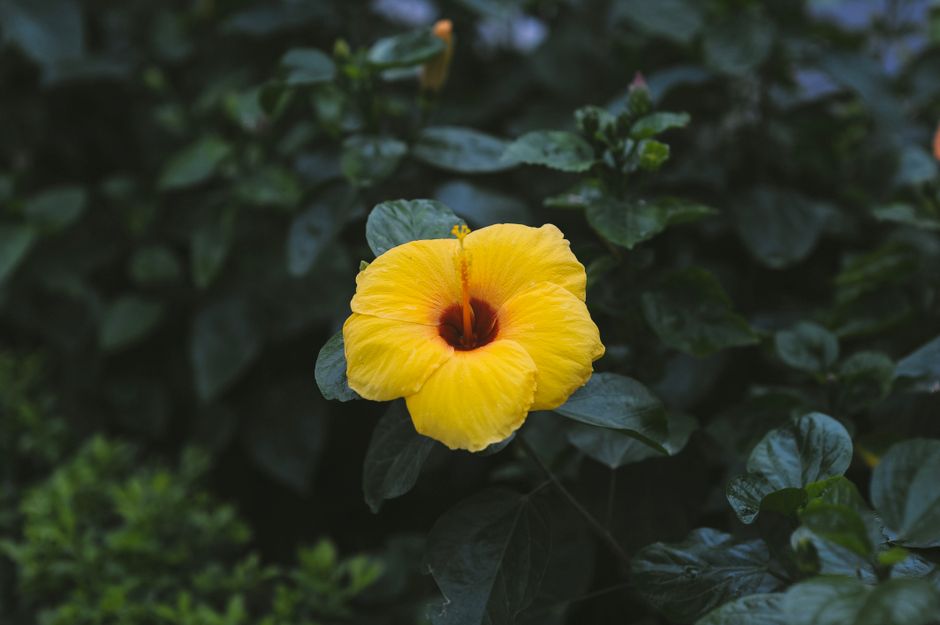
The yellow hibiscus, known in Hawaiian as pua aloalo, became the official state flower in 1988. It is frequently confused with the more common red Chinese hibiscus that dominates resort landscaping, but the two are quite different. The native yellow hibiscus (Hibiscus brackenridgei) has a specific appearance: large, delicate petals in a clear shade of yellow, often with a pronounced maroon or burgundy center. The petals are thinner and more papery than the waxy hybrids you see in garden centers. Hawaii is actually home to seven endemic hibiscus species, though most are rare and restricted to specific habitats.
Culturally, the hibiscus carries associations of hospitality, power, and respect. It is also at the center of one of the most persistent myths about Hawaiian flowers: the ear placement rule. According to tradition, a flower worn behind the right ear signals that you are single and available. Behind the left ear means you are taken or married. While this custom has roots in Hawaiian practice, it has been simplified and commercialized over time. Still, it remains a charming piece of floral etiquette that many locals observe with a wink.
Plumeria (Frangipani)
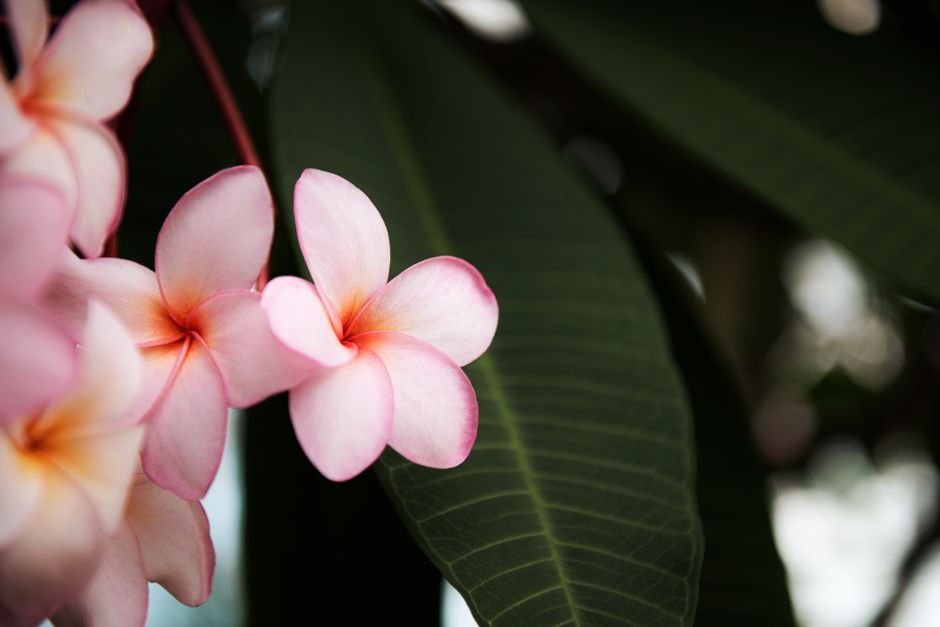
If any flower competes with hibiscus for the title of most iconic Hawaiian bloom, it is plumeria. The waxy, five-petaled flowers come in shades of white, yellow, pink, and deep red, often with a gradient that seems painted by hand. Their fragrance is unmistakable: sweet, heady, and strongest at dusk. Plumeria is not native. It arrived in 1860, introduced by a German botanist named William Hillebrand, and quickly naturalized across the islands.
Plumeria holds a special place in lei-making, but it also carries a more somber cultural weight. During World War II, sailors departing Pearl Harbor would throw plumeria leis into the ocean as a farewell ritual. If the lei floated toward shore, it was said the sailor would return. If it drifted out to sea, he would not. This tradition speaks to the lei's deeper meaning: it is not merely decoration but a vessel for intention, memory, and emotion. Proper lei disposal honors this weight. A lei should never be thrown in the trash. Instead, return it to the earth by hanging it from a tree, burying it, or burning it. The flowers came from the land, and they should return to it.
The Naupaka Legend (The Half-Flower)
Naupaka is one of the most distinctive flowers in Hawaii, and it comes with a story that elevates it beyond mere botany. The flower appears to be half of a blossom, as if someone cut it cleanly down the middle. The legend behind this appearance is a Hawaiian Romeo and Juliet. As the story goes, a beautiful princess fell in love with a commoner, a fisherman or farmer depending on the version. Their love was forbidden by the rigid class system, and the two were forced to separate. In their grief, they sought the help of a kahuna (priest), but no solution could be found. The gods, moved by their sorrow, transformed the princess into the mountain naupaka and the commoner into the beach naupaka, each bearing a half-flower that can only be made whole when the two are reunited.
This legend explains why there are two distinct types of naupaka. Beach naupaka (Scaevola taccada) grows along coastal areas, its white half-flowers facing the ocean. Mountain naupaka (Scaevola gaudichaudii) grows inland and at higher elevations, its flowers facing the mountains. The two are forever separated, just like the lovers in the story. When you encounter naupaka on a hike or at the beach, the legend adds an emotional layer that transforms a simple plant into a living piece of Hawaiian storytelling.
Pikake (Hawaiian Jasmine)
Pikake is a flower defined by its fragrance. The small, white blossoms of this jasmine species (Jasminum sambac) release an intense, sweet scent that intensifies in the evening. The name itself carries a story. Princess Kaʻiulani, the beloved heir to the Hawaiian throne during the turbulent final years of the monarchy, adored both this flower and the peacocks that roamed her estate. Pikake is the Hawaiian word for peacock, and she named the flower after her favorite birds.
Pikake leis are among the most treasured and expensive in Hawaii. The flowers are delicate, and stringing them requires patience and a gentle touch. A pikake lei is traditionally given for formal occasions, romantic gestures, or moments of deep respect. The vine itself thrives in humid, tropical environments and can be grown in home gardens with enough moisture and protection from harsh sun. Its cultural cachet remains unmatched: a single strand of pikake carries the weight of Hawaiian history and the memory of a princess.
Other Notable Blooms (Anthurium, Bird of Paradise, Heliconia)
Anthurium is instantly recognizable by its glossy, heart-shaped spathe and protruding spadix, which looks almost plastic in its perfection. The most common color is a vivid red, but cultivars now range from white to pink to deep burgundy. Samuel Mills Damon introduced anthurium to Hawaii in 1889, and the plant found ideal growing conditions in the volcanic soil and high humidity of the Big Island's east side. Cut anthurium flowers are remarkably long-lasting, often surviving two to three weeks in a vase, which makes them a staple of the commercial flower industry.
Bird of Paradise (Strelitzia reginae) is another non-native that has become synonymous with tropical landscaping. Its orange and blue blooms resemble a crane in mid-flight, a visual pun on its scientific name. Originally from South Africa, it thrives in Hawaii's climate and is commonly seen in hotel gardens, roadside plantings, and residential yards. It is striking but not culturally significant in the way native or canoe plants are.
Heliconia, sometimes called lobster claw, produces dramatic, pendulous bracts in shades of red, orange, and yellow. The flowers are small and hidden within these showy structures. Like Bird of Paradise, heliconia is a favorite for tropical floral arrangements and adds structural drama to gardens. It is not native but has found a comfortable home in Hawaii's warm, wet valleys.
The Hawaiian Lei: More Than Just a Flower Necklace
The lei is one of the most visible expressions of Hawaiian culture, but its meaning runs far deeper than a welcoming gesture at the airport. A lei is a symbol of aloha, a word that encompasses love, compassion, and mutual respect. It is given to celebrate birthdays, graduations, weddings, and achievements. It is offered in mourning and farewell. To give a lei is to honor the recipient. To receive one is to accept that honor with grace.
Lei-making is an art form with distinct techniques. The kui method involves stringing flowers through their centers using a needle and thread, creating the classic single-strand lei. Hili is a braiding technique, often used with ti leaves or ferns. Wili involves wrapping flowers and foliage around a central core, creating a fuller, more textured lei. Haku is a woven style that incorporates leaves and flowers into a flat band, traditionally worn on the head.
Different flowers carry different meanings in lei form. Plumeria leis are casual and cheerful, suitable for everyday celebrations. Pikake leis are formal and romantic, reserved for special occasions. Orchid leis, particularly purple dendrobium, are modern and long-lasting, popular for large events because they hold up well without refrigeration. For men, the maile lei is traditional: an open-ended strand of fragrant maile leaves, often worn at weddings and important ceremonies. It has no flowers at all, yet it is one of the most respected lei forms.
Lei etiquette is worth learning before you visit. Always accept a lei when offered. Refusing one is considered a rejection of the giver's aloha. Receive it with a hug and a kiss on the cheek, the traditional exchange. Do not remove a lei in front of the person who gave it, as this is seen as ungrateful. An old superstition warns against wearing a lei in the bathroom, though this is more practical than mystical: the humidity and odors can damage delicate flowers. Similarly, some believe you should not give a closed lei to a pregnant woman, as it may symbolize an umbilical cord around the baby's neck. This is a fading belief, but it persists in some circles.
When to See Hawaiian Flowers: A Seasonal Bloom Calendar for 2026
One of the joys of Hawaii's tropical climate is that something is always in bloom. Unlike temperate zones with distinct flowering seasons, the islands offer year-round color. Still, certain species have peak periods, and planning a 2026 visit around these can elevate your experience.
Year-round bloomers include hibiscus, bougainvillea, Bird of Paradise, and anthurium. These are the reliable showstoppers you will see regardless of when you travel. Bougainvillea, with its papery bracts in magenta, orange, and white, cascades over walls and fences in every season. Anthurium farms on the Big Island produce flowers continuously, supplying markets across the state and mainland.
Seasonal highlights add variety. Plumeria peaks from April through September, when the trees are heavy with blossoms and the air carries their sweet scent. This is the best window for lei-making workshops and for simply enjoying the sensory experience of walking under a plumeria canopy. ʻŌhiʻa lehua, the most important native tree in Hawaiian forests, blooms year-round but shows its most dramatic displays in spring and early summer. Its pom-pom flowers, typically red but occasionally yellow or orange, are critical nectar sources for native honeycreepers. Jacaranda, a non-native tree with spectacular purple flowers, puts on its show in late spring, typically May and June. The upcountry slopes of Maui, particularly around Kula, are famous for jacaranda season, when the roadsides turn into tunnels of lavender.
If you are choosing an island specifically for flower viewing in 2026, each offers distinct experiences. Maui combines accessible gardens with wild beauty. The Road to Hana passes through native forests where ʻōhiʻa lehua dominates the canopy. Upcountry farms and the Kula Botanical Garden showcase both native and introduced species in a cooler climate. The Big Island is unmatched for botanical diversity. Hawaii Tropical Botanical Garden near Hilo is a valley filled with palms, heliconia, and orchids. Volcanoes National Park offers the chance to see native silversword, a spiky, silvery plant that grows only on high volcanic slopes. Oahu provides excellent urban and curated options. Lyon Arboretum in Manoa Valley maintains a living collection of native Hawaiian plants, and Koko Crater Botanical Garden specializes in dryland species, including rare endemics.
Conservation: Protecting Hawaii’s Endangered Native Flowers
The beauty of Hawaii's flowers masks a crisis. The islands are often called the endangered species capital of the world, and native plants are at the forefront of this struggle. The Hawaiian gardenia, known as naʻu, is a federally-listed endangered species. Once common, it now exists in the wild as only a handful of individual plants. The culprit is a familiar trio: habitat loss from development and agriculture, competition from aggressive invasive species, and the cascading effects of climate change, including drought and shifting rainfall patterns.
Naʻu is not alone. ʻUki ʻuki, a native lily with striking blue berries, faces pressure from feral pigs and invasive grasses. Māmane, a tree that produces bright yellow flowers, is critical to the survival of the endangered palila bird, which feeds almost exclusively on its seeds. As māmane forests shrink, so does the palila population. The Cyanea genus, known in Hawaiian as hāhā, includes some of the rarest plants on Earth, with species that exist only as a few individuals in remote, fenced preserves.
Travelers can make a difference through simple, respectful behavior. Stay on marked trails to avoid trampling fragile seedlings and spreading invasive seeds on your shoes. Never pick wildflowers, no matter how abundant they seem. What looks like a healthy population to an untrained eye may be one of the last stands of a species. Support organizations doing on-the-ground conservation work, such as the National Tropical Botanical Garden, which maintains preserves on Kauai and Maui. When buying leis, ask about the source. Avoid any made from native or endangered species. Reputable lei makers use cultivated flowers like plumeria, orchid, and carnation.
Botanical gardens play an essential role as sanctuaries and seed banks. Limahuli Garden on Kauai's north shore is set in a valley that feels like a journey back in time, with terraced taro fields and native forest that shelters rare species. Visiting places like this funds conservation work and offers a glimpse of what Hawaii looked like before the waves of introduced species transformed the landscape.
Frequently Asked Questions About Flowers in Hawaii
What is the most common flower in Hawaii?
The hibiscus, specifically the Chinese hibiscus and its countless hybrids, is the flower you will see most frequently in landscaping and gardens. Plumeria, however, is arguably the most photographed and commercially recognizable.
What does wearing a flower behind your left ear mean?
Traditionally, a flower worn behind the left ear signals that you are taken, married, or otherwise unavailable. A flower behind the right ear indicates that you are single and open to romantic attention. This custom is observed casually and with a sense of fun rather than strict formality.
Can I grow Hawaiian flowers on the mainland?
Yes, with caveats. Plumeria can be grown in pots in colder climates if brought indoors during winter. Anthurium and orchids require high humidity and do well in greenhouses or bright bathrooms. Native Hawaiian plants are difficult to source ethically and often require very specific conditions that are hard to replicate outside the islands.
How long do Hawaiian flowers last?
Plumeria leis typically last two to three days if refrigerated. Anthurium cut flowers are remarkably durable, often lasting two to three weeks in a vase. Orchid leis hold up for about five to seven days with proper care.
What is the Hawaiian flower necklace called?
It is called a lei. While flowers are the most famous material, leis can also be made from leaves, shells, seeds, nuts, feathers, and even bone or ivory in traditional forms.
Your Journey with Hawaiian Flowers
From the endemic ʻōhiʻa lehua that sustains native forests to the introduced plumeria that scents the trade winds, Hawaiian flowers tell a story of migration, adaptation, and cultural resilience. Each bloom carries layers of meaning: botanical, historical, and spiritual. The half-flower naupaka reminds us of love and loss. The pikake whispers the name of a princess. The yellow hibiscus stands as a symbol of a unique natural heritage worth protecting.
As you plan your 2026 visit or simply deepen your appreciation from afar, let this guide serve as your companion. Identify the blooms you encounter. Respect the traditions they represent. Support the conservation efforts that ensure future generations will experience the same wonder. Whether you are hiking a volcanic slope, wandering a botanical garden, or receiving a lei with a hug and a kiss, understanding the flowers in Hawaii adds a layer of depth that transforms a beautiful sight into a meaningful connection.
